A Christmas Carol Historical Context
Setting the scene for A Christmas Carol: Understand the time and place that inspired its creation and relevance.

‘A Christmas Carol’ is one of Charles Dickens’s most beloved and commonly adapted pieces. Classed as a novella due to its size, it is separated into five parts.
About the Book

Article written by Lee-James Bovey
P.G.C.E degree.
The novel covers a broad range of themes, from what Christmas means to the wealth divide. Due to its popularity and accessibility, it is often taught in schools, especially in the UK, where it forms part of the GCSE syllabus.
Charles Dickens is one of the most famous British authors of all time and one of the most revered too. He is known for his witty prose, lengthy descriptive sentences, and for his social commentary. His best-known works include ‘A Christmas Carol’, ‘Great Expectations’, ‘Oliver Twist’, ‘A Tale of Two Cities’, and ‘The Pickwick Papers’.
He was born in Portsmouth and flourished despite a humble beginning. His father was sent to prison after falling into debt. Dickens took to factory work. Despite not receiving any formal education, he was able to rise above his station and wrote 15 novels, 5 novellas, and countless other works. His humble upbringing informs his various works and can be seen in some of his most memorable characters, such as Pip from ‘Great Expectations’.
Dickens became an influential celebrity. Because his writing appealed to the lower classes, they would often pay to have his work read to them, which helped reading become more mainstream. Prior to this transition, it was primarily a tool used by the upper classes.
Perhaps more than anything, Dickens’ calling card was his colourful characters. Dickens had a flair for larger-than-life characters and specialized in grotesquely opulent characters.
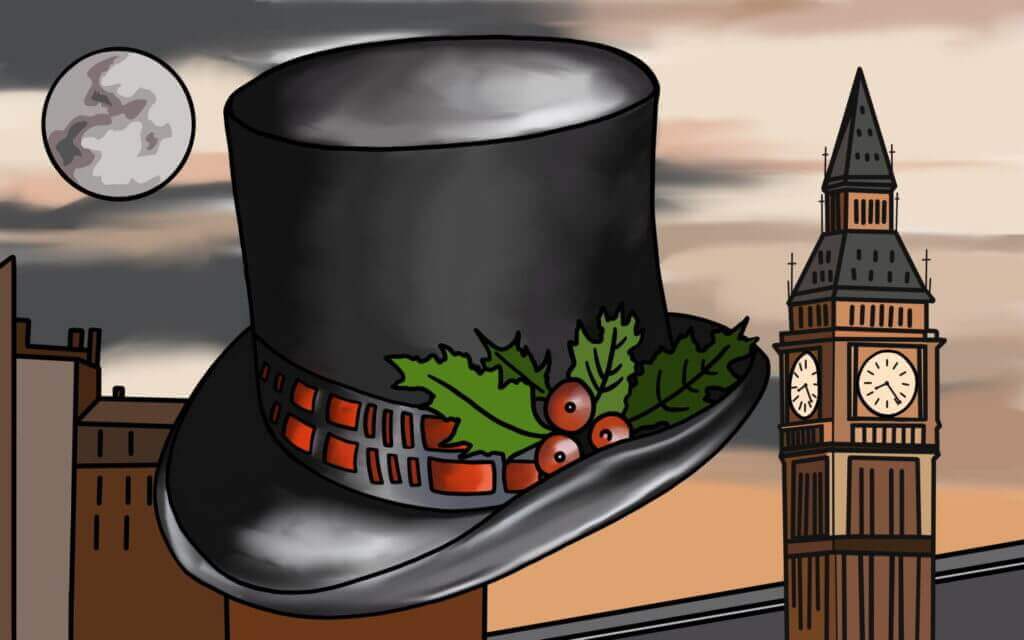
As with many of the greatest works of fiction, the story of ‘A Christmas Carol‘ is unique and does not fit comfortably within one single classification. Obviously, there are gothic elements in the tale with hints at time travel and the use of ghosts, as well as the wintry setting. However, at its heart, it is a tale of hope and redemption.
Other similar books include ‘The Secret Garden,’ which is a delightful children’s tale but overlooks the festive elements. One might look at something like the ‘Nightmare Before Christmas’ poem. It has elements of the gothic along with Christmas themes. Or if one wanted to explore books with themes of poverty, then most of Dickens’ work would be suitable.
This book has been frequently studied at schools and has therefore become etched in the consciousness of the public.
The book’s themes and the way it comments on poverty mean that it has become socially and even politically influential. Often, someone who is miserly is still referred to as a “Scrooge.” The book has affected the English language itself.
Of course, it is impossible to talk about the book’s legacy without mentioning its many adaptations. Some representations stick relatively close to the source material, such as the excellent film adaptation starring Patrick Stewart. Then some adaptations take a slightly more playful approach, such as the muppets ‘Christmas Carol’ and finally, there are reimaginings such as the hilarious ‘Scrooged,’ featuring Bill Murray.
Setting the scene for A Christmas Carol: Understand the time and place that inspired its creation and relevance.
Unlock the hidden meanings: Dive deeper into the central themes and symbolism, and analysis of A Christmas Carol.
Get to know the characters: Understand the characters in A Christmas Carol.
The words that resonate: Find memorable quotes from A Christmas Carol that capture its essence of the book.
What does a book expert think: Get a comprehensive overview of the reception and review of A Christmas Carol.
A Christmas Carol in a nutshell: A quick overview of the essential plot points, characters, and ideas.
P.G.C.E degree.