
Character List

From the resourceful Llewellyn Moss to the pathological ruthless killer Chigurh, "No Country for Old Men" features a remarkably memorable cast of characters.

An Overlook of the Main Characters

Protagonist

Llewelyn Moss Portrait Cartoon Art

Llewellyn Moss

Resourceful, determined, courageous.

A Vietnam War veteran who stumbles upon a drug deal gone wrong and takes a suitcase full of money, setting off a violent chain of events.

Antagonist

Anton Chigurh Portrait Cartoon Art

Anton Chigurh

Merciless, methodical, enigmatic.

A ruthless and enigmatic hitman hired to recover the money taken by Moss, characterized by his relentless pursuit and brutal methods. Chigurh uses a coin toss to determine whether his marks live or die.

Lawman

Sheriff Ed Tom Bell Portrait Cartoon Art

Sheriff Ed Tom Bell

Reflective, compassionate, weary.

The aging sheriff of the county who investigates the aftermath of the drug deal and tries to protect Moss. In his monologues, he reflecs on the changing nature of crime and morality.

Rating
Rating:
4.1/5

Continue down for all the characters to No Country for Old Men

Ebuka Igbokwe

Article written by Ebuka Igbokwe

Bachelor's degree from Nnamdi Azikiwe University.

The cast of characters in “No Country for Old Men” by Cormac McCarthy is diverse and memorable, serving as vehicles to explore the novel’s themes. While the story’s action is driven in a definite direction, the characters imbue it with layered meaning and multi-dimensional significance. Each character responds to the novel’s most seminal questions through their decisions and actions.

Llewelyn Moss

Role: Protagonist

Key Info: Vietnam War veteran, hunter, finds drug money.

Llewelyn Moss Portrait Cartoon Art
A welder and Vietnam War veteran whose discovery of a drug deal gone wrong sets off a violent chain of events.
Background: Llewelyn Moss is a welder and Vietnam War veteran who stumbles upon a drug deal gone wrong in the Texas desert. He finds a case containing two million dollars and takes it, setting off a deadly pursuit.
Personality: Moss is resourceful, determined, and often stubborn. Throughout the story, his independence and self-reliance drive much of his decision-making.
Development: Moss begins as a somewhat ordinary man thrust into extraordinary circumstances. His decision to keep the money and his subsequent attempts to evade his pursuers reveal his strengths and vulnerabilities.
Significance: Moss’s actions catalyze the novel’s events, bringing together the paths of the other major characters. His moral choices and consequences touch on the ideas of fate and survival and the violence associated with the drug trade.

Llewelyn Moss represents the everyman caught in a struggle beyond his understanding. His background as a Vietnam veteran underscores a familiarity with violence and survival. Yet, his encounter with the drug deal and the subsequent chase reveals a naivety to the relentless nature of his pursuers. Moss’s stubbornness and pride lead him to believe he can outsmart those after him, but his decision to keep the money ultimately seals his fate. Through Moss, McCarthy explores moral ambiguity, the illusion of control, and the inevitability of fate. Moss’s journey, marked by initial success and ultimate tragedy, reflects the harsh reality that even the most prepared and resilient individuals can fall victim to forces beyond their control.

Anton Chigurh

Role: Antagonist

Key Info: Hitman, psychopathic, relentless

Anton Chigurh Portrait Cartoon Art
A remorseless and enigmatic hitman who relentlessly pursues Moss to recover stolen money.
Background: Anton Chigurh is a ruthless hitman hired to recover the money Moss found. His methods are brutal and efficient, and he uses a captive bolt pistol to kill his victims.
Personality: Chigurh is cold and calculating. He adheres to a personal code of ethics that revolves around fate and chance. His lack of empathy and unpredictability make him terrifying.
Development: Chigurh remains largely unchanged throughout the novel, serving as a constant, implacable force of nature. His unwavering commitment to his code contrasts sharply with the other characters’ more flexible morals.
Significance: Chigurh embodies the themes of fate’s inevitability and the randomness of violence. He acts as a dark agent of chaos, bringing death and destruction in his wake.

Anton Chigurh embodies inevitable and arbitrary death, a force that cannot be reasoned with or deterred. His character challenges traditional notions of morality and justice as he operates according to his twisted logic. Chigurh’s use of a coin toss to decide his victims’ fates highlights the role of chance in life and death, stripping away any illusion of control. McCarthy uses Chigurh to explore the nature of evil and the idea that some forces are beyond human comprehension or influence. Chigurh’s interactions with other characters reveal their vulnerabilities and moral complexities. He is positioned as a mirror reflecting human nature’s darkest aspects.

Sheriff Ed Tom Bell

Role: Moral center

Key Info: Lawman, WWII veteran, introspective
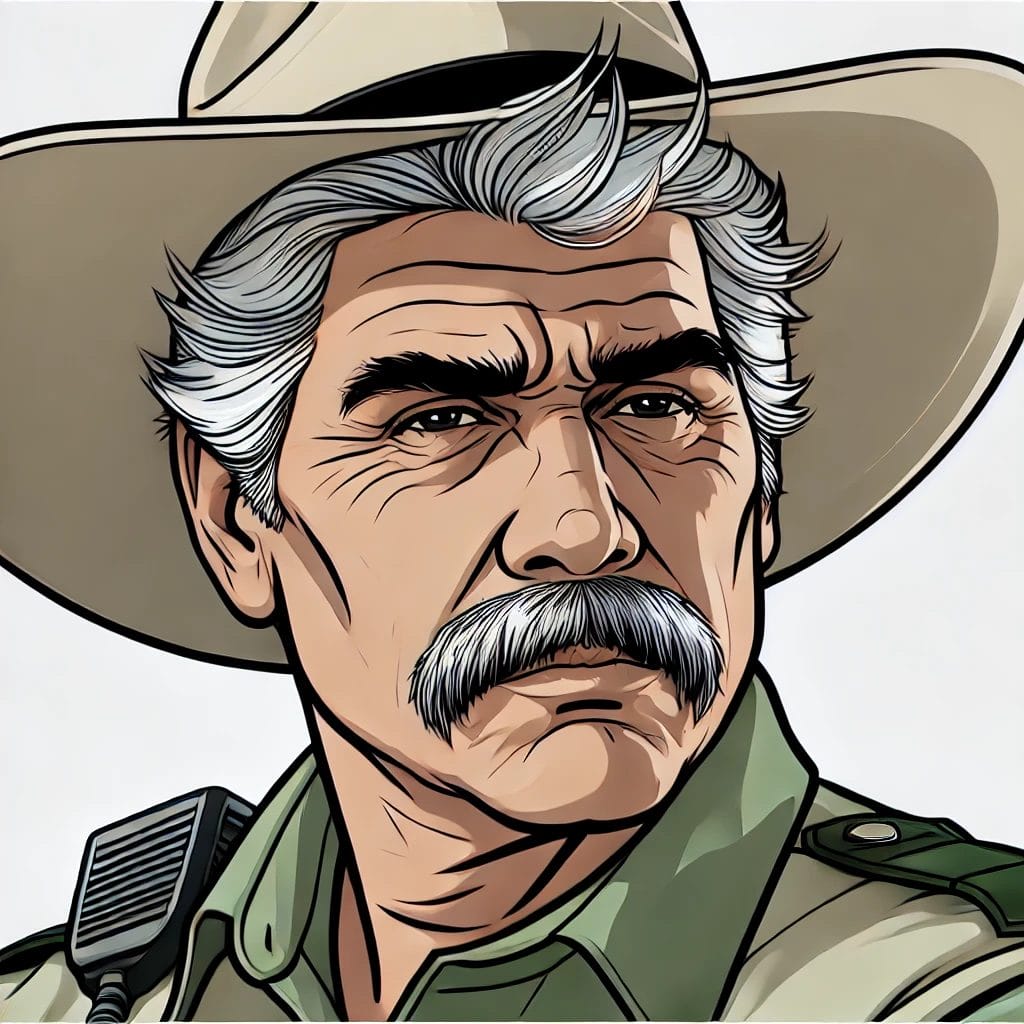
Sheriff Ed Tom Bell Portrait Cartoon Art
A weary and reflective lawman grappling with the increasing violence and moral decay in society.
Background: Sheriff Ed Tom Bell is an aging lawman who investigates the aftermath of the drug deal and the ensuing violence. A WWII veteran, he represents an older, perhaps outdated, moral code.
Personality: Bell is reflective, compassionate, and deeply troubled by the increasing violence and moral decay he witnesses. His introspection often contrasts with the action around him.
Development: Throughout the novel, Bell becomes increasingly disillusioned with his ability to combat the growing evil in the world. His final decision to retire signifies a surrender to the changing times.
Significance: Bell provides moral and philosophical commentary on the novel’s events. His reflections on duty, justice, and the nature of evil offer a counterpoint to Moss and Chigurh’s actions.

Sheriff Ed Tom Bell serves as the moral conscience of “No Country for Old Men“, grappling with his sense of duty and the erosion of traditional values. His reflections comment on how society changes and the law’s power against pervasive violence diminishes. Bell’s struggle to reconcile his past experiences with the present horrors highlights the generational shift in the face of escalating brutality. His eventual decision to retire acknowledges his limitations and the inevitability of change. Through Bell, McCarthy explores themes of morality, duty, and the passage of time, using his character to question whether the world has become more violent or if Bell’s perspective is simply a product of his bygone age.


Carla Jean Moss

Role: Supporting character

Key Info: Llewelyn Moss’s wife, innocent, tragic figure

Carla Jean Moss Portrait Cartoon Art
Llewelyn’s loyal and innocent wife, caught in the crossfire of her husband’s choices.
Background: Carla Jean Moss is Llewelyn’s young wife, who becomes an unwitting participant in the dangerous game her husband has entered. She is deeply affected by his decisions and the subsequent pursuit.
Personality: Carla Jean is loyal, loving, and innocent. Her deep care for Llewelyn, which leads to her ultimate fate, highlights her vulnerability.
Development: Carla Jean remains a largely static character, serving as an innocent bystander caught in the crossfire of her husband’s choices. Her tragic end stresses that violence sometimes claims collateral damage.
Significance: Carla Jean’s character emphasizes the loss of innocence and the human cost of violence. Her fate at the hands of Chigurh underscores the novel’s grim view of justice and morality.

Carla Jean Moss represents the human collateral in McCarthy’s brutal world. Her tragic fate, determined by Chigurh’s coin toss, highlights the arbitrary nature of violence and the helplessness of individuals caught in its wake. Her death reminds the reader of the personal and emotional costs of others’ brutal actions. She also critiques how people generally disregard human life in pursuing power and money. Through Carla Jean, McCarthy underscores the themes of innocence, sacrifice, and the often indiscriminate nature of fate.


Carson Wells

Role: Rival hitman

Key Info: Former special forces, professional, confident

Carson Wells Portrait Cartoon Art
A confident and experienced bounty hunter hired to track down both Moss and Chigurh.
Background: Carson Wells is a hitman hired by the same organization as Chigurh to retrieve the missing money. He presents himself as a more refined and professional alternative to Chigurh.
Personality: Wells is confident, professional, and somewhat arrogant. He believes he can handle Chigurh and retrieve the money without much trouble.
Development: Wells’s confidence ultimately leads to his downfall. His underestimation of Chigurh leads to his death, revealing the deadly seriousness of the situation.
Significance: Wells’s character contrasts Chigurh and Moss, highlighting different aspects of professionalism and the use of and approach to violence.

Carson Wells represents a middle ground between Moss’s moral ambiguity and Chigurh’s ruthlessness. His professional demeanor and confidence initially suggest a more controlled approach to the violent chaos. However, Wells’s arrogance and underestimation of Chigurh illustrate the fatal flaw of hubris. His swift and brutal end at Chigurh’s hand reminds us of Chigurh’s relentless efficiency and the futility of trying to control or predict such a force. Through Wells, McCarthy explores the limits of professionalism and the inherent unpredictability of violence. Wells’s interactions with Moss and Chigurh further develop the novel’s exploration of morality, competence, and the nature of true power in a lawless landscape.

Loretta Bell

Role: Supporting character

Key Info: Sheriff Bell’s wife, supportive, Bell’s moral anchor

Loretta Bell Portrait Cartoon Art
Sheriff Bell’s supportive and perceptive wife, offering him comfort and grounding.
Background: Loretta Bell is the wife of Sheriff Ed Tom Bell. She provides emotional support and stability for her husband, who is struggling with his sense of duty and the violent world around them.
Personality: Loretta is compassionate, patient, and wise. Her strong moral compass and unwavering support for her husband offer a grounding presence in his turbulent life.
Development: Loretta remains a consistent and stabilizing force throughout the novel. Her role is largely static, contrasting the chaos faced by the other characters.
Significance: Loretta’s character underscores the themes of loyalty, love, and the importance of stabilizing personal relationships amidst violence and moral decay. She represents the hope and resilience found in relationships with loved ones.

Loretta Bell embodies Sheriff Bell’s traditional values of loyalty, love, and faith. Her unwavering support and understanding give him the strength to face the horrors of his job, even as he grapples with his disillusionment. Loretta’s presence highlights the contrast between the chaotic external world and the sanctuary of home and family. Through Loretta, McCarthy emphasizes the importance of personal relationships and the moral grounding they can provide in a world seemingly bereft of order and justice. Loretta’s calm and patient demeanor also highlights the emotional turmoil and inner conflict experienced by her husband, making her an essential counterbalance in the narrative.


Uncle Ellis

Role: Supporting character

Key Info: Sheriff Bell’s uncle, a retired lawman, disabled

Uncle Ellis Portrait Cartoon Art
Sheriff Bell’s disabled uncle, who provides wisdom and perspective on the challenges of aging and justice.
Background: Ellis is Sheriff Ed Tom Bell’s uncle, a retired lawman living on a Texas ranch. He is confined to a wheelchair due to an injury sustained during his service as a sheriff.
Personality: Ellis is wise, stoic, and somewhat resigned. His conversations with Bell reveal his deep understanding of the nature of evil and the harsh realities of life.
Development: Ellis is a static character, offering Bell wisdom and perspective. His role does not involve significant personal change, but he plays a crucial part in Bell’s introspection and understanding of his limitations.
Significance: Ellis’s character provides historical and familial context for Bell’s struggles. His reflections on the past and the changing nature of violence help to illuminate the novel’s themes of morality, duty, and the passage of time.

Ellis serves as a crucial source of wisdom and perspective for Sheriff Bell, grounding the narrative in a broader historical context. His reflections on his own experiences as a lawman and the injuries he sustained highlight the enduring nature of violence and the personal costs of a life spent in service to the law. Ellis’s resigned attitude towards the inevitability of evil and the limitations of human effort contrasts with Bell’s more active struggle against these forces, emphasizing the generational differences in their outlooks. Through Ellis, McCarthy balances out Sheriff Bell’s moral disillusionment, representing the idea that, despite their best efforts, individuals cannot always control or combat the larger forces of chaos and violence. Ellis’s conversation with Bell provides a crucial moment of introspection that underscores the novel’s meditation on the passage of time and the eternal struggle between good and evil.


The Hitchhiker

Role: Minor character

Key Info: Young woman meets Llewelyn Moss, symbolizes innocence

The Hitchhiker Portrait Cartoon Art
A young woman who encounters Llewelyn Moss during his flight, embodying innocence amidst chaos.
Background: The hitchhiker is a young woman Llewelyn Moss encounters on the run. Despite the inherent risks, she is trying to make her way to California and accepts a ride from Moss.
Personality: The hitchhiker is naive, trusting, and hopeful. Her youthful innocence and optimism starkly contrast with the grim realities faced by Moss.
Development: Due to her brief appearance in the novel, the hitchhiker does not undergo significant development. Her character serves more to highlight aspects of Moss’s character and the dangerous world they inhabit.
Significance: The hitchhiker symbolizes the innocence and hope that are easily destroyed by the harsh world depicted in the novel. Her fate serves as a poignant reminder of the collateral damage caused by the violent conflicts between the main characters.

The hitchhiker’s brief presence in the narrative serves as a poignant contrast to the violence and moral ambiguity that defines the novel. Her naive trust in Moss and her dreams of reaching California represent a fleeting glimpse of innocence and hope. However, her encounter with Moss ultimately leads to her tragic fate, underscoring the novel’s grim view of the world. Through the hitchhiker, McCarthy illustrates the random and often cruel nature of violence, highlighting how innocent lives can be irrevocably damaged or ended by forces beyond their control. Her character also serves to humanize Moss, revealing his protective instincts and his internal conflict as he tries to navigate the perilous situation he finds himself in. The hitchhiker’s tragic end is a stark reminder of the pervasive and indiscriminate nature of the violence that permeates the novel.

Join Book Analysis for Free!

Exclusive to Members

Get access now

Save Your Favorites

Less Ads

Free Newsletter

Comment with Literary Experts

Ebuka Igbokwe

About Ebuka Igbokwe

Bachelor's degree from Nnamdi Azikiwe University.

Ebuka Igbokwe is the founder and former leader of a book club, the Liber Book Club, in 2016 and managed it for four years. Ebuka has also authored several children's books. He shares philosophical insights on his newsletter, Carefree Sketches and has published several short stories on a few literary blogs online.

Subscribe
Notify of
guest
0 Comments
Inline Feedbacks
View all comments

Discover the secrets to learning and enjoying literature.

Join Book Analysis

Learn More

Share to...