

“Brave New World” was published in 1932. It was Aldous Huxley’s fifth novel and introduces us to a prescient social commentator and a brilliant storyteller whose ideas about a possible future are as compelling as they are believable.
Huxley explored a novel idea in this book: presenting a world of pleasure and contentment as a dystopia. What began as a parody of an idea of a utopia he read in “Men Like Gods” by H. G. Wells was transformed into one of fiction’s most remarkable conceptions of dystopias.
Revisiting Brave New World
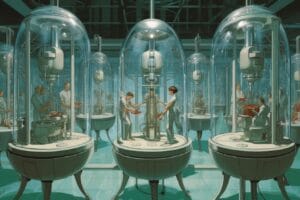
Huxley envisions a future society where people are engineered in hatcheries and conditioned for specific roles. Pleasure, consumerism, and conformity are paramount in this highly controlled world. The government uses behavioral conditioning and a drug called soma to maintain social stability.
The story follows Bernard Marx, an individual who struggles with his conditioned place in society, and John, a “savage” from a reservation where the customs of old times persist. As John is introduced to the “civilized” world, he becomes a focal point for the novel’s exploration of the clash between individuality and a society obsessed with controlling its citizens with conformity-inducing pleasurable activities.
The novel explores how technology can dehumanize people, the effects of mass production and consumption on society, and the hollowness of a culture driven by instant gratification. It raises questions about the costs of sacrificing individuality for social stability.
A World of No Pains, All Gains
“Brave New World” presents a unique plot for dystopias. Huxley imagines a world where everyone but the rebels are kept content and pleased by a government that controls all aspects of civilian life through technology. In such a world, people do not face anxieties or prolonged wants because their social infrastructure responds to these and provides for any lack. The subtle danger, as seen in the development of the novel, is that the individuals in the society were stunted in development, as they were prevented from having their ideas, feelings, and desires and were channeled into ends predetermined by the system. Huxley made the premise work because he set out to satirize his contemporaries’ common conceptions of utopia. Sometimes, his satire seems to work too well. The reader is almost convinced that the dystopia of the World State is not such a bad place to live in. At least, compared to life in the Reservation, the other place explored in the novel, Mustapha Mond’s London, is a choice habitat.
The tension between individuality and conformity is a central theme in the novel, and the book raises important questions about the cost of sacrificing individuality for societal cohesion. The World State produces its citizens by using genetic engineering and conditioning in factory-like settings. The citizens thus created are made to exact specifications and fit for exact roles, thus reducing human beings to mere commodities or cogs in a machine. This raises valid ethical questions, such as how much society can do to make the individual fulfill the needs of the state to which it belongs. “Brave New World” explores consumerism as a dominant social value and critiques a culture driven and controlled by constant consumption and instant gratification.
The theme of technology and its use in social control highlights the novel’s concern with its potential misuse to manipulate and dominate individuals. While these are valid fears, Huxley can be accused of being heavy-handed in his criticism of technology use. In the novel, he hardly speaks approvingly of an instance where technological advance is an unequivocal good. He also fails to give a nuanced treatment of where the line between anarchy and individual freedom or between healthy social order and oppressive rule lies.
Characterization in “Brave New World” is a key element in its narrative, and Aldous Huxley uses a range of characters to serve specific purposes.
Characters like Bernard Marx and John “the Savage” embody different critiques of their society, contributing to the novel’s depth. The characters in the novel often have distinct traits and personalities that make them memorable, and they undergo personal struggles that add emotional depth to the narrative. Bernard is dissatisfied because he is an Alpha without the traits of an Alpha and feels slighted by the lack of respect he gets from those he deals with. On the other hand, Helmholtz is an Alpha’s Alpha, and his dissatisfaction stems from having experienced all Alpha can have and become bored. Consequently, both of them express their rebellion in different ways. Bernard is resentful; Helmholtz is worldly-weary, aloof, and cynical. Another important detail is how Huxley introduces characters with contrasting perspectives, and the clash between their views presents a platform for exploring the novel’s theme to great lengths.
One of the shortcomings of the novel’s characterization is Huxley’s use of the characters as didactic pieces, making them feel less like realized humans and more like instruments. Also, the novel does not discuss the background of some of its major characters, like Mustapha Mond or Lenina Crowne, which limits readers’ understanding of their motives.
Generally, Huxley’s writing style is clear and accessible, although he uses complex diction and often employs a scientific tone and jargon in exposition. He uses satire and irony to drive home his points subtly but in a way that stimulates the reader, as seen in his use of hypnapaedic phrases, which subvert the meanings of common expressions. His description is detailed and evocative, painting a vivid and immersive image of the futuristic World State. He probes complex and profound philosophical and social issues in very approachable language. Huxley uses literary and historical allusions, which give concepts in his story an anchor of realism.
The story structure of “Brave New World” is simple and sparse. This makes it a perfect vehicle for the profound and imaginative ideas explored in the story in a way that does not overwhelm the reader.
From Bernard’s romance with Lenina, which leads to their trip to the reservation in the first arc of the story, to John’s immigration to World State from the reservation in the second, we learn much about the strange world, can identify with and understand the characters responding to the events in it, and Huxley ably handles the topical issues he intended to with the story.
The story is fast-paced, and Huxley seamlessly weaves exposition into the story without feeling like he is dumping information on the reader. The novel experiences, such as the games and other leisure activities, of the citizens of World State are integrated into the narrative.
The world-building is creative and ambitious and plays a crucial role in shaping the novel’s narrative. A futuristic World State with advanced technology, genetic engineering, and conditioned social norms provides a rich backdrop for exploring the novel’s dystopian themes. The novel is set in 632 A.F. (After Ford), equivalent to the 26th century, marking a new era where society venerates Henry Ford, the father of modern assembly line production. This shift reflects the society’s emphasis on efficiency, uniformity, and mass production, extending beyond industrial practices to encompass all aspects of human life. Cities in the World State, such as London, are highly structured and sanitized environments, featuring towering buildings and advanced infrastructure. The urban landscape lacks natural elements, reflecting society’s disconnection from the natural world and its obsession with artificial control and order.
Also, including the Savage Reservation in the story as a contrasting setting adds depth to the narrative by highlighting the clash between traditional and futuristic societies. It allows for a comparison between different ways of life. Aldous Huxley’s carefully crafted setting serves as a platform for his critique of contemporary social trends, including mass production, consumerism, and the potentially dehumanizing consequences of choosing hedonism as the ultimate social goal.
One major pro of “Brave New World” is Huxley’s brilliant subversion of the dystopian trope, in that he satirizes popular utopias to show how hollow and inconducive to the human spirit a pleasure-oriented world is. Another plus is how compact and masterful his world-building is, focusing on only aspects of the futuristic world that drive the story forward and spare attention from unnecessary details. Also, the characters are well-developed, credible to their history, and serve to explore the different philosophies presented in the book.
On the cons, Huxley develops so finely the dystopia of a pleasure-filled, perpetually content society that he blurs the line between an oppressive government and a good one. This ambiguity may lead some readers to believe the World State is a true paradise. Huxley appears technophobic in that he does not make clear that he protests the abuse of technology rather than technological advances. In almost all instances where advanced technology is featured in the story, it is abused. Finally, no female characters are positively portrayed in the novel. Of the two major female characters in the story, Lenina is described as an airhead, and Linda is a hopeless soma addict.
In all, “Brave New World” has had a profound and enduring impact on literature, culture, and societal discourse since its publication in 1932. As one of the most influential dystopian novels of the 20th century, it has sparked continuous reflection and debate on the ethical implications of technological advancement, government control, and consumerism.
Its presentation of a society obsessed with hedonism and control has become a benchmark for evaluating contemporary societal trends and humanity’s potential future. The novel also remains a staple in academic curricula, prompting discussions on literature, philosophy, sociology, and ethics. In particular, it resonates in conversations about modern technological advancements and increasing concerns about privacy, surveillance, and bioethics, challenging contemporary readers to consider the balance between technological progress and preserving human values in society.
Brave New World: A Dystopian Vision of Technocratic Control
Book Title: Brave New World
Book Description: Written by Aldous Huxley, this is a dystopian novel that explores a future society where technology, conditioning, and genetic engineering control every aspect of human life. Citizens are bred for specific roles, conditioned to accept their predetermined social status, and kept content through a drug called soma.
Book Author: Aldous Huxley
Book Edition: Modern Classics Edition
Book Format: Paperback
Publisher - Organization: Harper Perennial
Date published: October 18, 2006
ISBN: 978-0060850524
Number Of Pages: 288
-
Plot
-
Setting
-
Characterization
-
Dialogue
-
Writing Style
-
Lasting Effect on Reader
Brave New World: A Dystopian Vision of Technocratic Control
In ‘Brave New World,’ Huxley critiques consumerism, societal mass control, and hedonism. He foretells specific themes relevant to our modern age. Still, like most dystopian creators, he focuses more on the negatives of his world and offers little positives in his vision of the future.
Pros
- Engaging narrative
- Compelling characters
- A masterful exploration of philosophical themes
Cons
- Heavily didactic writing
- Limited exploration of alternative views
- Somewhat technophobic in tone